1. What a CV should do
A CV is a targeted document that shows why you are a strong fit for a specific role. It should not read like a complete life history or a general list of everything you have done. A strong CV helps the reader quickly understand your training, expertise, achievements, impact, and future potential.
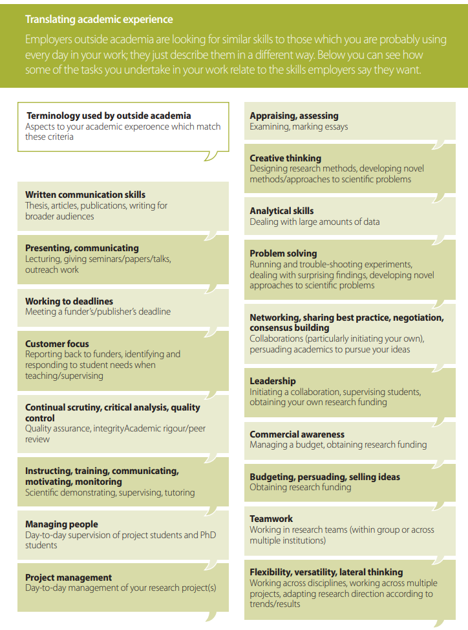
For academic role, CV should highlight research productivity, teaching, mentoring, funding, service, and scholarly identity. For non-academic roles, the CV should translate research experience into skills, outcomes, leadership, communication, project management, and problem-solving.
2. Keep a master CV
Maintain one detailed master CV that includes everything you have done. This document is for you, not for submission.
- Education and qualifications
- Research positions and projects
- Publications and manuscripts
- Grants, fellowships, and awards
- Teaching and mentoring
- Technical and analytical skills
- Conference presentations and invited talks
- Leadership and service roles
- Journal reviewing and editorial work
- Outreach and science communication
- Workshops, training, and certifications
- Collaborations and professional memberships
- Relevant non-academic experience
Update it regularly. Add details while they are fresh, especially numbers, outcomes, dates, titles, roles, and evidence of impact.
3. Tailor every CV
Before submitting a CV, ask:
- What type of role is this?
- What does this institution value?
- Which parts of my experience are relevant?
- What should appear first?
- What can be shortened, moved, or removed?
- What evidence shows that I meet the criteria?
Do not send the same CV everywhere.
4. Common sections in an academic CV
Contact information
- Full name
- Current position and institution
- Email; Phone, if needed
- Professional website, Google Scholar, ORCID, LinkedIn, or lab profile
Avoid unnecessary personal information.
Education
- Degree
- Discipline
- Institution
- Location
- Year
- Dissertation title, if relevant
- Adviser, if relevant
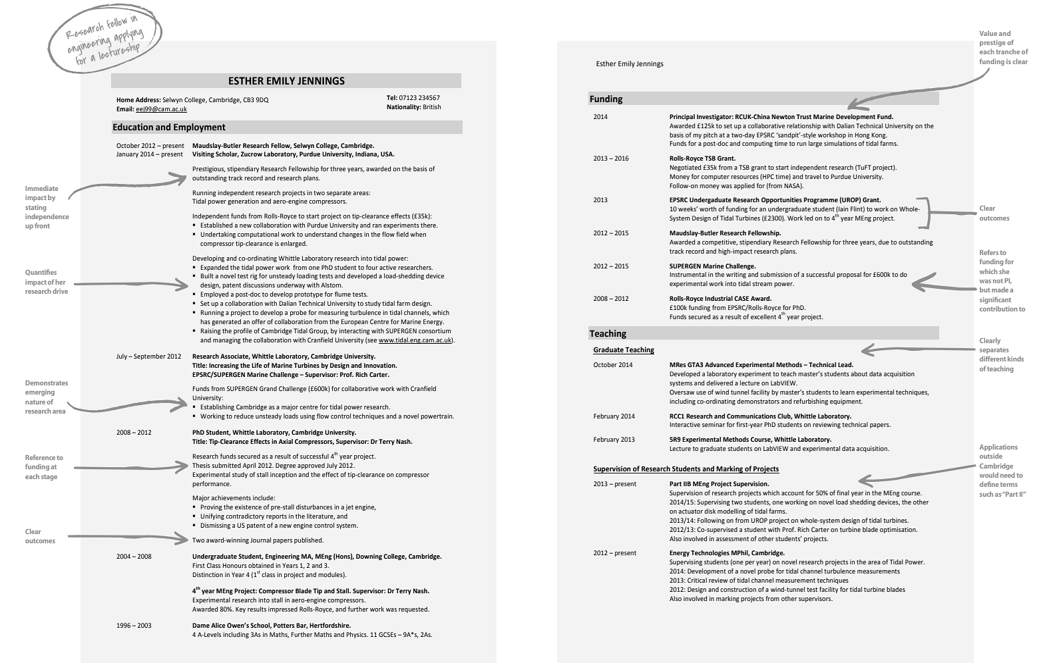
Academic appointments / research experience
- Position title
- Institution and department
- Dates
- Adviser or PI, if relevant
- Research focus
- Major methods
- Your contribution
- Key outcomes
It should show what you did and what came from it.
Publications
- Peer-reviewed journal articles
- Review articles
- Book chapters
- Manuscripts under review
- Manuscripts in preparation
- Conference proceedings
Clarify contribution where useful, especially for equal authorship, first authorship, corresponding authorship, or interdisciplinary work.
Grants, fellowships, and funding
- Name of grant or fellowship
- Funding agency
- Amount, if appropriate
- Your role
- Year
- Competitiveness, if known
Add brief context if the award is not self-explanatory.
Teaching experience
- Course title
- Role
- Institution
- Level of students
- Format, such as lecture, lab, discussion, guest lecture, workshop
- Class size, if useful
- Teaching outcomes or student feedback, if available
Mentoring and supervision
- Undergraduate students
- Graduate students
- Interns
- Visiting scholars
- Junior researchers
- Lab trainees
Mention outcomes when possible, such as thesis completion, conference presentation, manuscript contribution, award, skill development, etc.
Research and technical skills
Group skills by category rather than writing a long list. Example categories:
- Material production and modification
- Instrumental analysis
- Statistical analysis
- Field and greenhouse experiments
- Scientific writing and visualization
Presentations
- Invited talks
- Oral presentations
- Poster presentations
- Conference presentations
- Departmental seminars
- Public talks
Invited talks should be separated when possible because they show recognition.
Service and leadership
- Committee roles
- Journal reviewing
- Editorial work
- Conference organization
- Symposium planning
- Professional association leadership
- Outreach
- Peer mentoring
- Departmental service
Show both responsibility and impact.
Professional memberships
Include relevant societies, associations, or professional networks.
References
For academic applications, references are often included unless instructions say otherwise. Use referees who know your research, teaching, mentoring, and professional potential.
5. Formatting principles
Use:
- Clear headings
- Reverse chronological order within sections
- Consistent date formatting
- Consistent bullet style
- Simple font
- Balanced spacing
- Bold text for role, institution, or section headings
- Short, focused bullets
Avoid:
- Overcrowded pages
- Multiple fonts
- Too much bolding, italics or underlining
- Long paragraphs
- Unnecessary tables
- Unclear abbreviations
- Vague headings like “Other”
- Personal details that are not relevant to the role
6. How to tailor the CV
For a postdoc position, emphasize:
- Technical skills
- Research methods
- Fit with PI’s project
- Publications
- Ability to work independently
- Ability to collaborate
- Evidence of project completion
- Future research direction
For a tenure-track position, emphasize:
- Research identity
- Publications
- Funding potential
- Future research agenda
- Teaching experience
- Mentoring
- Service
- Departmental fit
- Independence from previous mentors
For a teaching-focused faculty position, emphasize:
- Teaching experience
- Course design
- Student mentoring
- Inclusive teaching
- Teaching evaluations, if strong
- Pedagogical training
- Ability to teach required courses
- Research that can involve undergraduates
For an industry research role, emphasize:
- Technical expertise
- Applied research outcomes
- Project delivery
- Data analysis
- Teamwork
- Patents or product-relevant outputs
- Problem-solving
- Ability to work across teams
For a non-research role, emphasize:
- Communication
- Writing
- Leadership
- Project management
- Data interpretation
- Stakeholder engagement
- Event organization
- Policy, outreach, administration, or program experience
7. Common CV mistakes
- Sending a generic CV to every position.
- Listing duties without outcomes.
- Making broad claims without evidence.
- Giving equal space to everything.
- Hiding the most relevant experience.
- Using too much technical jargon.
- Including too many unrelated details.
- Using inconsistent formatting.
- Writing long paragraphs instead of focused bullets.
- Not clarifying contribution in collaborative work.
- Listing publications without organizing them.
- Forgetting teaching, mentoring, service, leadership.
- Not matching the CV to the job description.
- Having an online profile that does not match the CV.
8. Final key message
A strong CV is not the longest CV. It is the clearest, most relevant, and most evidence-based version of your professional story. It should help the reader quickly answer:
- What have you done?
- Why does it matter?
- Why are you a strong fit for this role?
Category | Academic | Industry / R&D | Non-academic / Non-research |
| Main purpose | Shows scholarly identity, research impact, teaching potential, and academic contribution. | Shows ability to deliver research projects, apply technical expertise, and contribute to product, process, or company goals. | Shows transferable skills, problem-solving ability, communication, leadership, and fit with the role. |
| Length | Flexible and longer, depending on career stage and field. | Usually 2 pages, sometimes with a publication appendix. | Usually 1–2 pages. |
| Main focus | Publications, research trajectory, grants, teaching, supervision, invited talks, academic service. | Technical expertise, project delivery, data analysis, collaboration, patents, tools, practical outcomes. | Communication, project management, leadership, teamwork, analysis, writing, stakeholder engagement. |
| Research experience | Emphasize questions, methods, originality, contribution to the field, and outcomes. | Emphasize methods, tools, problem-solving, reproducibility, deadlines, and applied value. | Translate research into analytical thinking, evidence-based decisions, writing, planning, and managing complexity. |
| Publications | Full list, with role or contribution clarified where useful. | Summarized if relevant, with selected publications or appendix. | Briefly summarized only if useful as evidence of productivity or writing skill. |
| Teaching | Include courses, level, format, class size, supervision, curriculum development, and outcomes. | Reframe as training, mentoring, technical communication, and explaining complex ideas. | Reframe as communication, facilitation, public speaking, mentoring, and audience adaptation. |
| Mentoring | Shows ability to supervise students and build a future research group. | Shows ability to guide junior staff and support project delivery. | Shows leadership, team development, and people management. |
| Technical skills | Important, especially for postdoc and research roles. | Very important and often central to shortlisting. | Include only if directly relevant to the job. |
| Awards and grants | Evidence of reputation, competitiveness, and funding potential. | Evidence of achievement, initiative, and research success. | Evidence of excellence, recognition, and ability to secure resources. |
| Service and leadership | Shows academic citizenship, reviewing, committee work, outreach, and leadership. | Reframe as organization, quality control, collaboration, and leadership. | Reframe as administration, event planning, stakeholder engagement, and team coordination. |
| Evidence | Publications, grants, invited talks, student outcomes, citations, awards, service. | Metrics, deliverables, tools, patents, reports, workflow improvements, project outcomes. | Numbers, outcomes, responsibilities, leadership examples, communication products, deadlines. |
Category | CV | Resume |
| Purpose | Detailed academic/ professional record | Short, targeted job application document |
| Length | Can be several pages | Usually 1–2 pages |
| Used for | Faculty jobs, postdocs, fellowships, grants, academic roles | Industry, nonprofit, government, consulting, admin, communication roles |
| Focus | Research, teaching, publications, grants, awards, service | Skills, experience, achievements, job fit |
| Detail level | Comprehensive | Selective |
| Publications | Usually listed fully | Only selected or summarized |
| Teaching/ research | Described in academic detail | Translated into skills and outcomes |
| Audience | Academic committees, funders, research institutions | Recruiters, hiring managers, employers |
| Best summary | “What is my full academic record?” | “Why am I right for this specific job?” |